Engineered Structures Generate Internal Tensile Stress Under External Compression Without Changing External Response
- Share
- Tweet
- Send to email
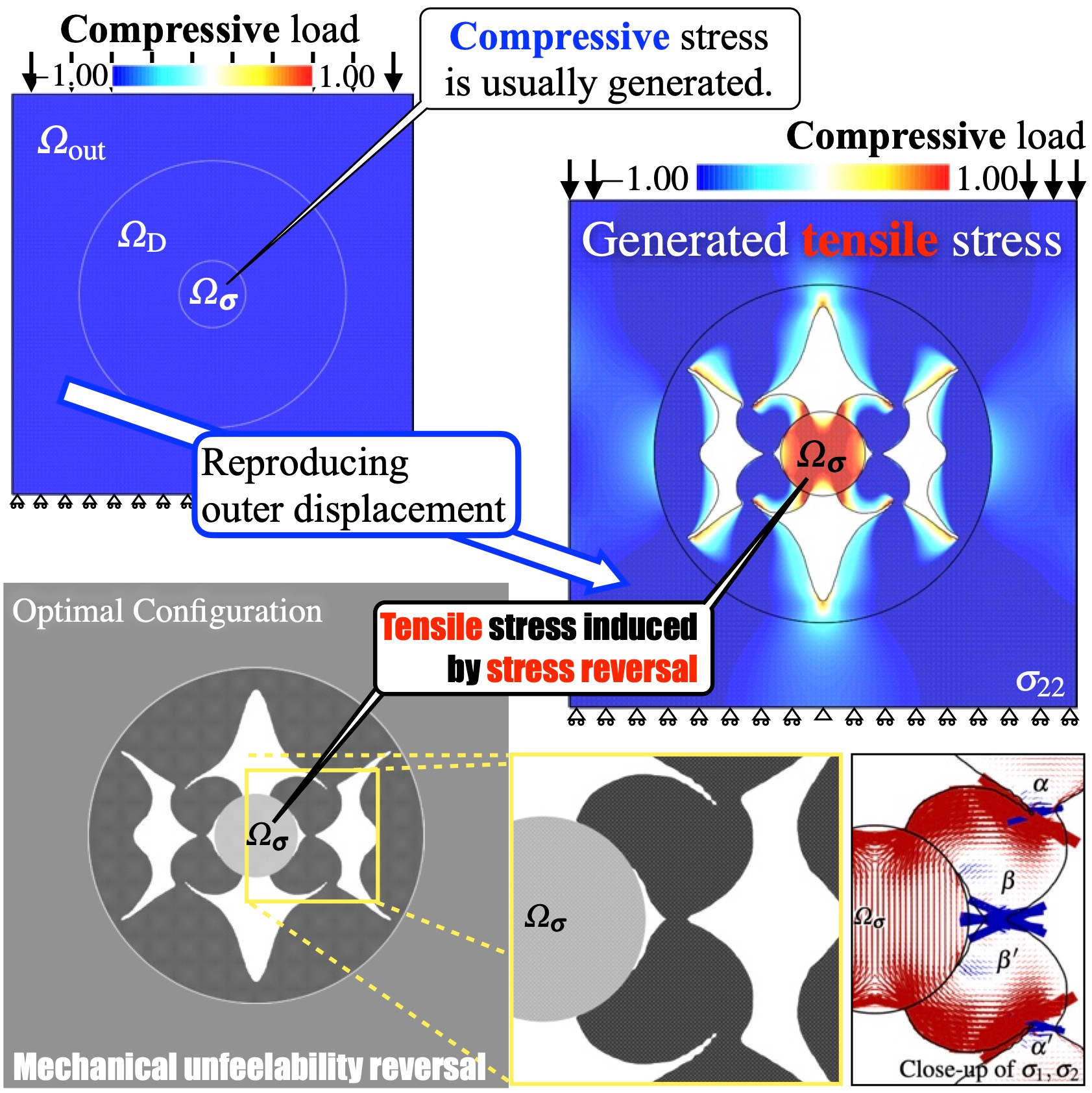
Image title: A topology optimization framework for internal stress reversal under external compression
A computational design approach uses topology optimization and geometry-induced stress redistribution to generate tensile stress within a selected region of a structure under external compression, while maintaining an almost unchanged outer displacement field. The concept, termed ‘mechanical unfeelability reversal,’ could inform the development of mechanical metamaterials and advanced structures for controlled stress management.
A topology optimization approach reverses internal stress under external compression, preserving an almost unchanged external displacement field
Because conventional structures subjected to external compressive loading typically develop internal compressive stress, the possibility of intentionally generating internal tensile stress under such loading conditions has been largely overlooked in conventional solid mechanics. Using the topology optimization framework, a new study demonstrates how compressive loading can generate internal tensile stress while maintaining an almost unchanged external displacement field. The findings introduce a concept called ‘mechanical unfeelability reversal,’ offering new possibilities for engineering advanced mechanical metastructures and metamaterials with flexibly tailored internal stress distributions.
In elastic mechanics, when a material is externally compressed, the naturally developed internal stresses are in the same direction as the applied load. The possibility of intentionally reversing the internal stress direction under such loading conditions has largely been overlooked in conventional structural design. Yet the ability to tailor internal stress distributions at will is a fundamental goal in mechanical design. This empowers researchers to exploit structural geometry to manipulate internal stress distributions in ways that are difficult to achieve with conventional structures. The researchers demonstrated the ability to intentionally generate internal tensile stress under external compression, thereby enabling the deliberate design of internal stress fields within structures.
In a new study, Professor Garuda Fujii of the Faculty of Engineering at Shinshu University, Japan, investigated whether topology optimization, a computational method for determining how material should be arranged to achieve a desired mechanical response, could generate internal tensile stress under external compression while preserving an almost unchanged displacement field outside the designed region. The concept, termed ‘mechanical unfeelability reversal,’ combines two functions: simultaneous stress reversal and mechanical cloaking. The study is published online on February 01, 2027, in the Journal of the Mechanics and Physics of Solids.
“This concept can help in the development of advanced metastructures that enable versatile control of internal stress distributions, creating unconventional behaviors that are impossible with conventional mechanical systems.,” says Prof. Fujii. “The framework can help in stress management by internal architecture customization, which can redirect stress direction at will and enable the design of structures with tailored stress distributions, potentially opening new possibilities for advanced mechanical metamaterials and structural engineering.”
For the study, numerical simulations were used to examine a two-dimensional structure under compression. The framework optimized the distribution of solid material and voids around an internal target region to produce tensile stress there.
Using the breakthrough concept of ‘mechanical unfeelability reversal,' the outer displacement field remains almost identical to the homogeneous reference, despite the presence of the stress-reversing internal structure. A third objective function was introduced to minimize the magnitude of lateral stress, thereby ensuring a more complete stress reversal in the target region.
The optimized structure developed a distinctive, spreader-type structure. Stress analysis indicated that this architecture redirects the applied compressive load through a series of geometry-induced bending interactions, resulting in stress reversal across nearly the entire target region, with tensile stress generated in 99.6% of the target region. Further analyses examined material stiffness, structural parameters, loading direction, and optimization conditions. Stress reversal and lateral-stress suppression remained robust to changes in material stiffness, although cloaking performance was more sensitive to the stiffness contrast.
“The optimized geometry produces a sequence of bending responses that reorient the load paths within the structure. This geometry-induced reconfiguration redistributes the applied compressive stress, enabling tensile stress to develop in the target region without substantially changing the external displacement field,” explained Prof. Fujii.
The findings could offer new avenues for designing advanced mechanical metastructures and metamaterials, with potential applications in components fabricated through additive manufacturing. By demonstrating that topology optimization can manipulate internal stress distributions beyond conventional structural limits under external loading, this research challenges the conventional assumption in structural engineering that compressive stress develops along the compressive external loading direction. Demonstrating that internal tension can be generated under external compression, while maintaining an external displacement field nearly identical to that of a homogeneous reference structure, provides engineers with an unprecedented degree of design freedom. “In the long term, this capability could open new possibilities for stress engineering, structural reliability, and performance enhancement in high-stakes engineering fields, including aerospace, mechanical, and civil engineering,” concluded Prof. Fujii.
Reference
Title of original paper: Mechanical unfeelability reversal: Generating internal tensile stress under external compression without disturbing outer displacement
Journal: Journal of the Mechanics and Physics of Solids
Related SDGs