Shinshu University Study Tracks RAMP3's Role in Breast Cancer Immunity in Mice
- Share
- Tweet
- Send to email
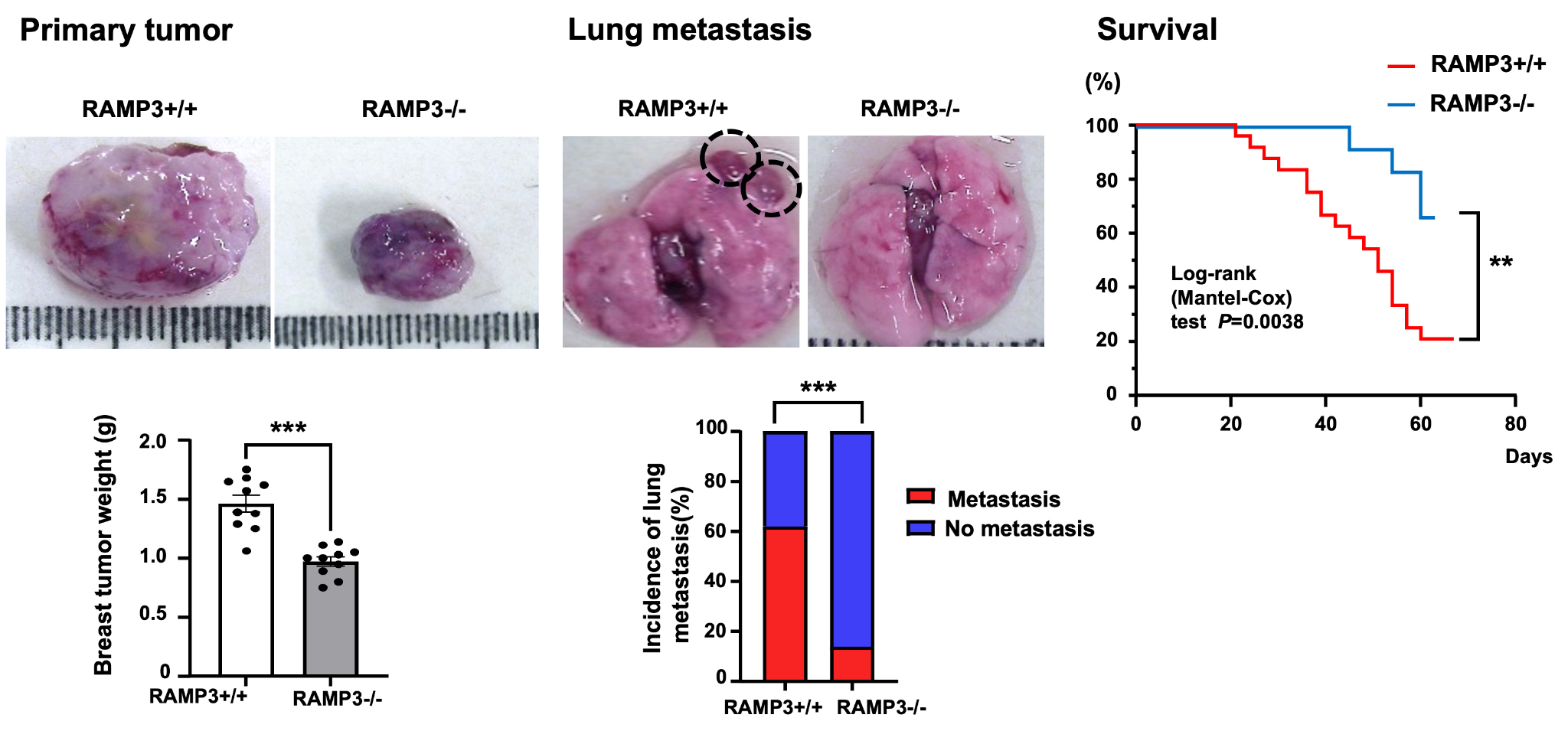
Image title: RAMP3 Deficiency Reduces Breast Tumor Growth and Lung Metastasis in Mice
Researchers found that mice lacking RAMP3 had lower primary breast tumor weights (left), a lower percentage of mice with lung metastases (center), and longer survival (right) than wild-type mice. Representative images of primary tumors and lungs appear above the corresponding graphs. Dashed circles indicate lung metastatic nodules.
Image Credit: Yan Zhang and Megumu Tanaka, Shinshu University, Japan
Researchers found that removing RAMP3 changed immune cells in mouse breast tumors and enhanced responses to immunotherapy
A new study found that mice lacking RAMP3 had fewer immune-suppressing macrophages and more cancer-fighting T cells in breast tumors. Researchers observed smaller tumors, less spread to the lungs, and longer survival. In a small experiment, these mice showed a greater survival benefit from anti-PD-1 immunotherapy. The findings suggest RAMP3 may be a potential target for future breast cancer treatment, but further studies are needed before its relevance to patients is known.
Cancer immunotherapy uses the body's defenses to attack cancer, but it does not help every patient. One reason may be the environment surrounding a tumor. Macrophages normally clear damaged cells, but some can suppress immune responses inside tumors, making it harder for cancer-fighting cells to work.
A research team, led by doctoral student Yan Zhang, along with Dr. Megumu Tanaka and Professor Takayuki Shindo from the Department of Cardiovascular Research, School of Medicine, Shinshu University, Japan, studied receptor activity-modifying protein 3 (RAMP3), which had previously been linked to stromal regulation in cancer. In mouse breast cancer models, they compared tumor growth, lung spread, survival, immune cells, and response to anti-programmed cell death protein 1 (PD-1) treatment when RAMP3 was present or genetically removed. They also analyzed single-cell and spatial data and public breast cancer patient data. The study was published in Volume 24 of the Journal of Translational Medicine on September 26, 2026.
Mice lacking RAMP3 developed smaller primary tumors, had less spread to the lungs, and lived longer than mice with the gene. Their tumors contained fewer immune-suppressing macrophages and more CD8+ T cells, which can attack cancer cells. These findings suggest that removing RAMP3 changed the tumor environment in ways that supported immune activity.
Further analyses offered clues about how this happens. Without RAMP3, macrophages were less likely to adopt an immune-suppressing state. The researchers found reduced activity in the IL-4/STAT6 signaling pathway, which is involved in this process, and lower levels of CCL8, a molecule associated with immune suppression. In laboratory experiments, inhibiting MCP-family chemokine production reduced the tumor-promoting effect of macrophages on breast cancer cells, supporting a role for RAMP3-associated chemokine signaling in tumor progression.
The team also tested anti-PD-1 treatment, which helps immune cells attack cancer. In a small exploratory experiment with five mice per group, mice lacking RAMP3 showed a greater survival benefit from treatment. This result is preliminary and needs confirmation.
“Immune cells can fight cancer, but the environment around a tumor can prevent them from working effectively,” says Dr. Tanaka. “We want to understand how to change that environment so these cells can do their job. Our findings in mice give us a reason to investigate RAMP3 further as a possible treatment target.”
The researchers also analyzed data from The Cancer Genome Atlas breast cancer cohort. A risk score combining RAMP3, CD163, a macrophage-associated marker, and CD8A, a marker linked to cancer-fighting T cells, was associated with poorer overall survival. The association remained significant after adjustment for established clinicopathological factors. However, this does not prove that targeting RAMP3 would help patients or predict immunotherapy benefit.
“Our earlier work suggested that RAMP3 helps shape the environment around tumors, so we wanted to understand whether it also affects macrophages and response to immunotherapy,” says Ms. Zhang.
“The next step is to test whether a drug that blocks RAMP3 can reproduce the effects seen in mice lacking the gene,” says Prof. Shindo.
Overall, the study identifies RAMP3 as a possible contributor to immune suppression in breast tumors and supports further research into it as a treatment target. The research was mainly conducted in mice, and deleting a gene throughout the body differs from treatment with a drug. The small immunotherapy experiment needs confirmation, and the human data do not establish treatment benefit. More research is needed to determine whether RAMP3 can be targeted safely and effectively in people.
Reference
Title of original paper: RAMP3 is associated with macrophage-driven immune exclusion and promotes resistance to PD-1 blockade in breast cancer: integrated in vivo and single-cell transcriptomic analyses
Journal: Journal of Translational Medicine
Related SGDs