Shinshu University Study Tracks Rising Autism and ADHD Diagnoses Across Japan
- Share
- Tweet
- Send to email

Image title: Rising Autism and ADHD Diagnoses Across Age Groups in Japan
Researchers examined national trends in autism spectrum disorder (ASD) and attention-deficit/hyperactivity disorder (ADHD) diagnoses in Japan from 2010 to 2023, identifying increasing diagnoses across age groups and a distinct second peak in ADHD diagnoses among young adult women. The findings highlight changing diagnostic patterns and the need to plan appropriate support for children and adults.
National data reveal a shift in adult diagnoses and a second peak in ADHD diagnoses among women aged 20–24 years
A new study using national health insurance data found that diagnoses of autism spectrum disorder and attention-deficit/hyperactivity disorder are rising in Japan. Researchers identified a second ADHD diagnosis peak among women aged 20 to 24 years and found that adult ADHD diagnoses surpassed autism diagnoses in 2013 among females and 2014 among males. The findings may help services plan support, while highlighting that diagnosis trends do not necessarily indicate rising prevalence.
Autism spectrum disorder (ASD) and attention-deficit/hyperactivity disorder (ADHD) are increasingly diagnosed in Japan, and the rise is no longer limited to children. National data show that adult ADHD diagnoses have overtaken ASD diagnoses, while young adult women have experienced a distinct increase. These trends may reflect greater awareness and changing diagnostic practices, rather than increased prevalence.
A research team was led by Associate Professor Daimei Sasayama from the Department of Psychiatry at Shinshu University School of Medicine, Japan, along with Professor Hideo Honda from the Department of Child and Adolescent Developmental Psychiatry at the same University. The researchers analyzed Japan’s National Database of Health Insurance Claims and Specific Health Checkups, covering approximately 99% of the population, to examine newly recorded diagnoses from fiscal years 2010 to 2023, after a washout period in fiscal year 2009. The study was published online in Volume 9, Issue 10 of the journal JAMA Network Open on October 20, 2026.
The analysis included 1,621,682 newly diagnosed patients with ASD and 1,483,470 with ADHD. Diagnoses for both conditions were most frequent among children aged 5 to 9 years. However, adult ADHD diagnoses surpassed ASD diagnoses among females in 2013 and males in 2014. Among females, a second ADHD peak emerged at ages 20 to 24 around 2017; by 2020, rates in this group approached the childhood peak.
Based on 2023 diagnosis rates, the researchers projected cumulative risks of receiving a diagnosis by age 49 of 15.7% for ASD and 14.2% for ADHD. Projected risks were higher in males than females for both conditions: 19.4% versus 11.9% for ASD and 16.9% versus 11.4% for ADHD. These are projections based on observed diagnosis patterns, not measurements of community prevalence or confirmed lifetime risks; the authors caution that rapidly changing diagnostic trends limit these estimates. Of people diagnosed with both conditions, 46.3% received both diagnoses simultaneously; among those diagnosed at different times, an ASD diagnosis more often came first.
“As a child psychiatrist, I have been supporting a growing number of children with these conditions in my clinic,” Dr. Sasayama explains. “I wanted to know whether what I was seeing reflected a nationwide trend, and to understand the actual situation of ASD and ADHD diagnoses across Japan, in both children and adults.”
The findings have practical implications for schools, universities, workplaces and healthcare services. Diagnosis figures can help planners anticipate demand for assessments, follow-up care and support, including extra test time, quieter workspaces and flexible working arrangements. The increase among young adult women highlights the need for accessible adult services.
The authors suggest that requirements for formal diagnoses to access support may contribute to high diagnosis rates, although this possibility was not directly tested in the study. However, people with difficulties in attention, organization or social communication may not meet diagnostic criteria or may be unable to access assessment. Relying entirely on a medical label can leave these people without support and add pressure to healthcare services.
Dr. Sasayama also emphasized the need for inclusive support, by stating “We must change society so that everyone is accommodated fairly, whether or not they have a diagnosis.”
Overall, the findings point to a need to understand changing ASD and ADHD diagnosis patterns and their drivers. The researchers emphasize continued monitoring and further investigation, and fair accommodation regardless of diagnosis.
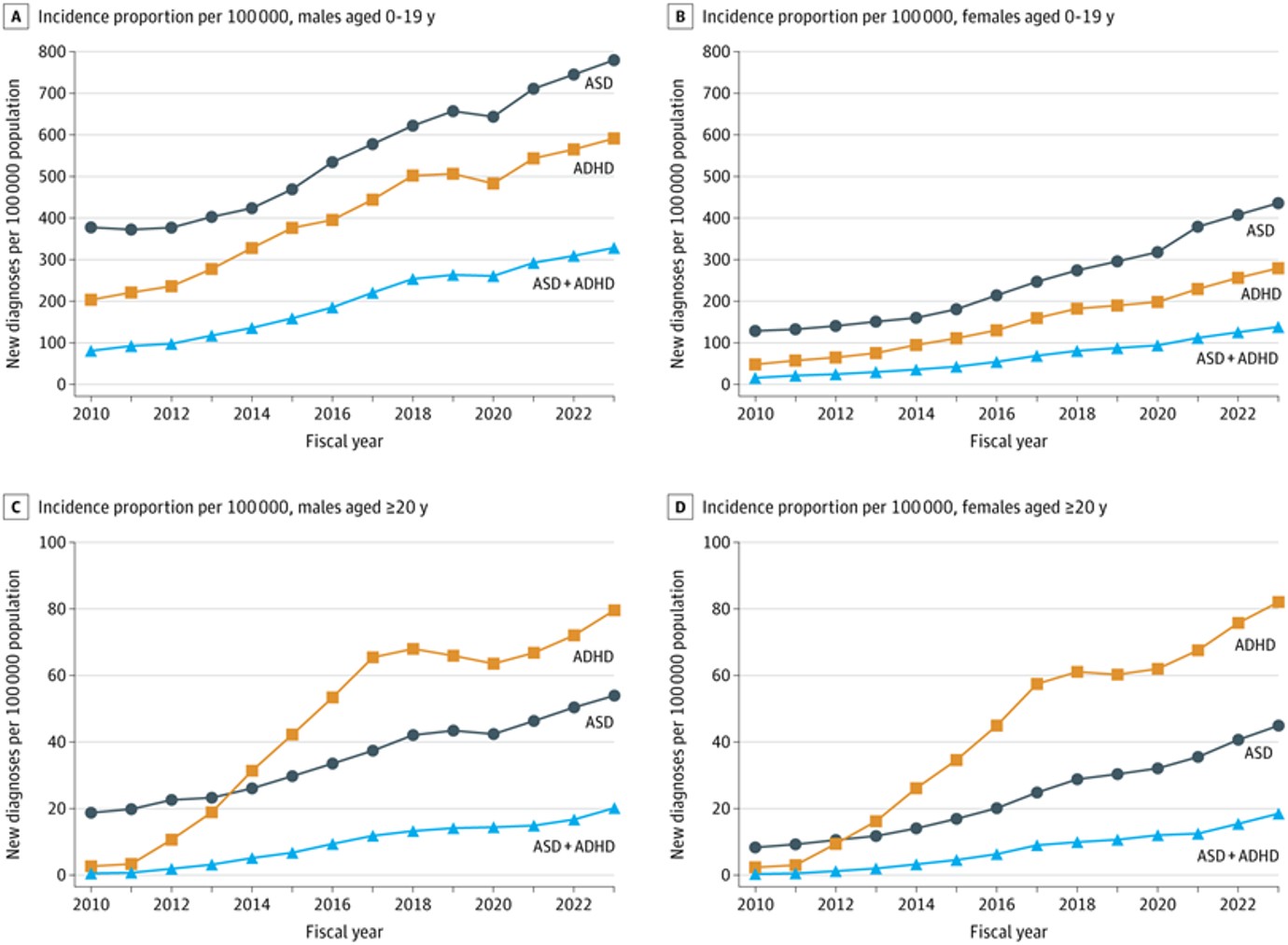
Image title:Trends in Autism and ADHD Diagnoses Across Age Groups in Japan
Researchers illustrate annual incidence proportions of new ASD and ADHD diagnoses per 100,000 people in Japan. Diagnoses for both conditions increased among children, with ASD rates remaining higher than ADHD rates. Among adults, ADHD diagnoses surpassed ASD diagnoses among females in 2013 and males in 2014. The graphs also show diagnoses among people with both conditions.
Reference
Title of orginal paper : Incidence of Autism Spectrum Disorder and Attention-Deficit/Hyperactivity Disorder in Japan
Journal : JAMA Network Open
Related SDGs