

Water-Retaining Hydrogel Electrode Stabilizes Insect-Antenna Odor Sensors for Seven Hours and Supports Drone-Based Odor Detection
- Share
- Tweet
- Send to email
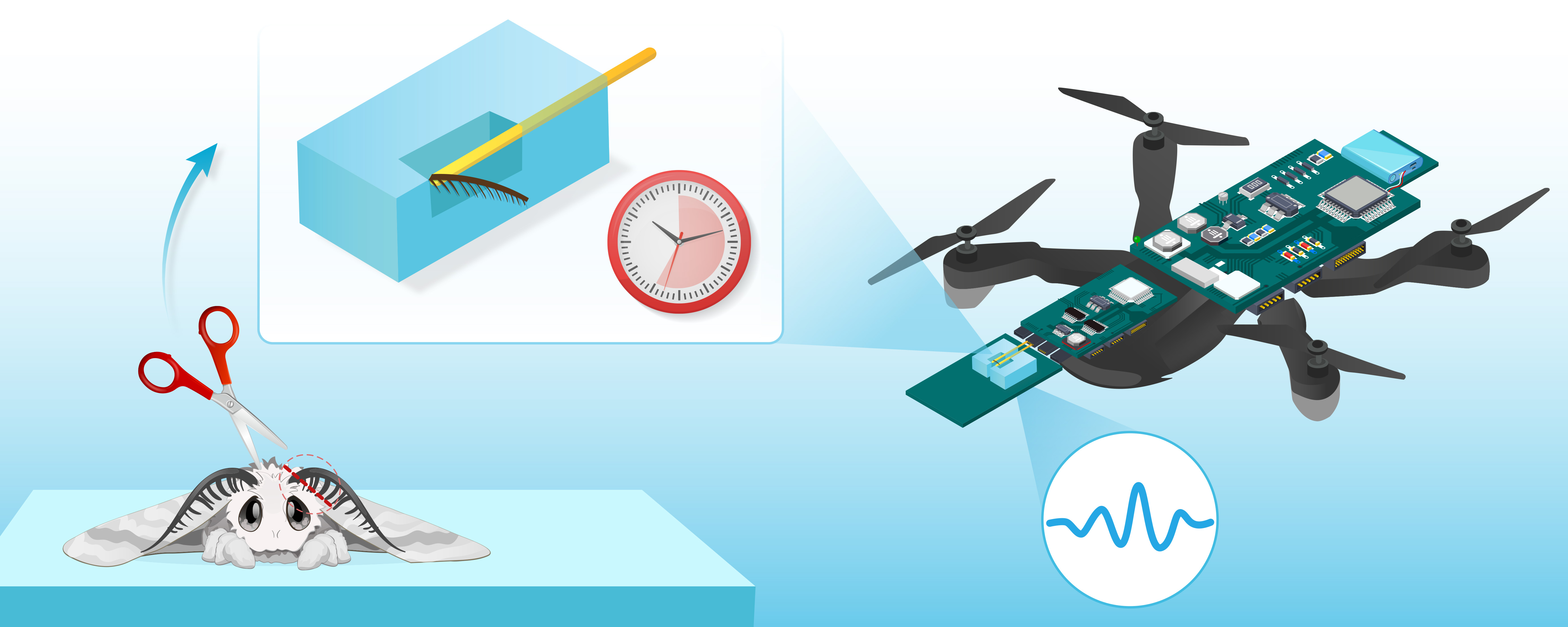
Image title: Water-retaining hydrogel electrode stabilizes an insect-antenna odor sensor for biohybrid drones
Image caption: Researchers from Shinshu University and Chiba University developed a water-retaining hydrogel electrode that stabilizes the contact between an excised silkworm moth antenna and an electroantennogram (EAG) sensing system. The hydrogel helps retain moisture around the antenna–conductive gel contact, allowing the insect-antenna sensor to maintain odor responses for up to 7 hours under tested indoor, room-temperature conditions. The stabilized sensor was also mounted on a small drone, where odor-evoked signals were used to trigger forward motion.
Image credit: Dr. Daigo Terutsuki from Shinshu University, Japan
Biohybrid odor sensor inspired by insect olfaction could support future disaster response, environmental monitoring, and hazardous chemical detection
Insects possess abilities to detect chemical signals in their surroundings, inspiring the development of a generation of biohybrid sensing technologies. Researchers at Shinshu University and Chiba University are harnessing the remarkable odor-sensing capabilities of silkworm moth antennae and integrating them with drone platforms. Their latest research focuses on improving the interface between biological sensors and electronic systems, advancing the development of mobile sensing platforms designed to detect airborne chemical signals in complex and challenging environments.
Drones are increasingly being used for disaster response, infrastructure inspection, and environmental monitoring. However, most drone systems rely primarily on cameras and other visual sensors, which can become ineffective in smoke, dust, darkness, or collapsed structures. Odor sensing could provide a valuable complementary capability by enabling drones to detect gas leaks and chemical emissions that cannot be identified through visual sensing alone. Yet a major challenge has limited their practical use of such biohybrid sensors: excised insect antennae gradually lose signal quality as they dry out and the electrical interface becomes unstable.
To address this challenge, researchers from Shinshu University and Chiba University have developed a water-retaining hydrogel electrode that stabilizes the interface between insect antennae and recording electrodes, extending the usable recording time of biohybrid odor sensors. These sensors record electroantennogram (EAG) signals—the electrical responses produced by insect antennae when exposed to odors. The study was made available online on July 2, 2026, and will be published in Volume 467, Part 1 of Sensors and Actuators B: Chemical on November 15, 2026. The research was led by Associate Professor Daigo Terutsuki from the Faculty of Textile Science and Technology at Shinshu University, together with graduate student Reina Omori, undergraduate student Kie Kondo, Associate Professor Yosuke Kageshima of Shinshu University, and Associate Professor Toshiyuki Nakata of Chiba University.
“Improving how far an odor-tracking drone can search is only part of the challenge. Its biological sensor must also remain stable long enough to work on a moving platform. We therefore focused on the antenna–electrode interface and developed a hydrogel structure that helps maintain a hydrated contact environment for several hours,” says Dr. Terutsuki.
To overcome these limitations, the electrode combines a hydrogel, a conductive gel layer, a gold-plated core, and a 3D-printed frame. The moisture-retaining hydrogel creates a stable environment around the antenna while maintaining reliable electrical coupling during EAG recording.
The team evaluated the hydrogel electrode using excised antennae from male silkworm moths (Bombyx mori). Under tested indoor, room-temperature conditions, the electrode maintained more than 92% of the initial EAG response amplitude after seven hours. By contrast, the conventional grooved gold-plated metal electrode fell below the study’s predefined 50% practical-usability threshold by four hours. Electrochemical impedance measurements supported more stable electrical coupling in the hydrogel electrode assembly during the first hour.
To examine whether the stabilized sensor could operate on a mobile platform, the researchers mounted it on a lightweight drone. During proof-of-concept experiments, the sensor successfully detected odor-evoked EAG signals, while in separate proof-of-concept free-flight tests, EAG threshold crossings triggered a programmed stop-and-advance sequence. Rather than demonstrating optimized odor-source localization, these experiments showed that the stabilized biohybrid interface can support drone-mounted odor sensing under the tested flight conditions.
By improving the stability of the antenna–electrode interface, the hydrogel addresses one of the key barriers to deploying insect-based odor sensors outside the laboratory. The hydrogel helps maintain a hydrated electrical contact, extending the usable EAG recording window for several hours. This longer recording window could facilitate future development of biohybrid sensing systems for mobile robotics and environmental monitoring.
The researchers highlight the potential impact of stable biohybrid odor sensing in real-world environments. “In disaster-prone regions such as Japan, longer-lasting biological odor sensors could become a key component in future search-and-rescue systems after earthquakes,” shares Dr. Terutsuki. He adds, “In industrial settings, they could enable mobile detection of gas leaks or chemical emissions in areas that are difficult or dangerous for humans to access.”
The study demonstrates how engineering a simple biohybrid interface can significantly improve the practicality of insect-derived odor sensors. By extending stable EAG recording and enabling proof-of-concept drone-mounted odor sensing, the work provides a foundation for future biohybrid sensing platforms that could support disaster response, hazardous chemical monitoring, infrastructure inspection, and environmental monitoring.
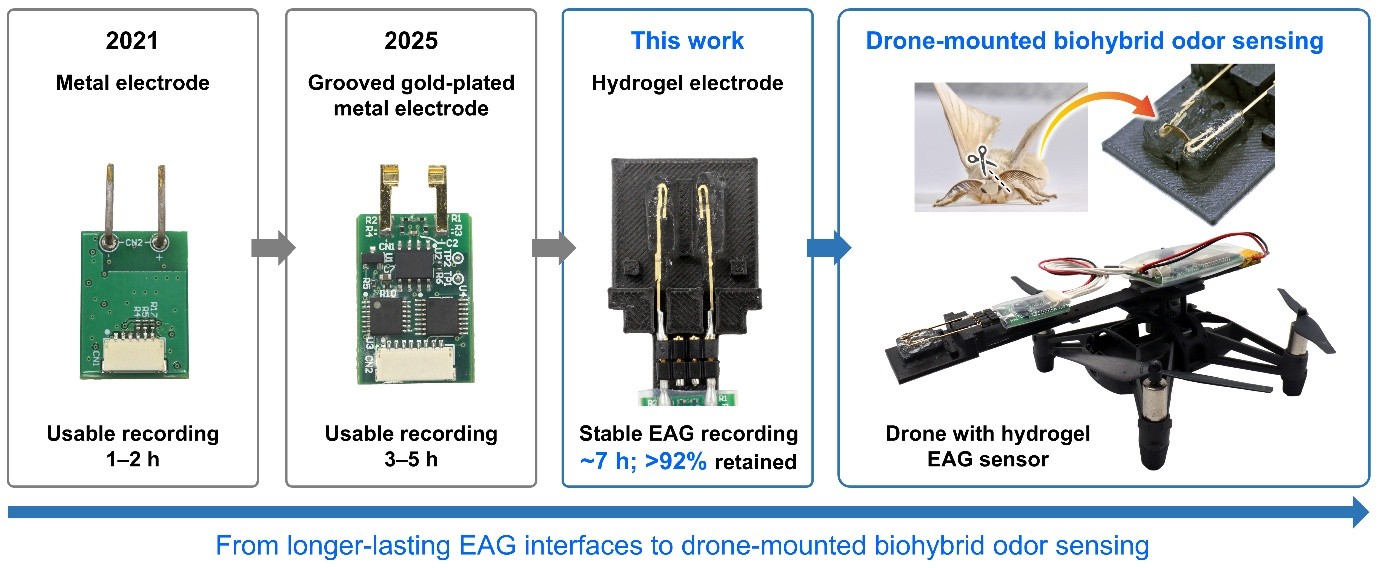
Image title: Evolution of EAG electrodes toward drone-mounted biohybrid odor sensing
Image caption: The research team has improved the electrode design for insect-antenna EAG sensing over several studies. Early metal electrodes supported short-term recording, while grooved gold-plated metal electrodes improved the usable recording duration. In the present study, the team introduced a hydrogel structure that retains moisture around the antenna–conductive gel contact, enabling stable EAG recording for up to 7 hours under tested conditions.
Image credit: Dr. Daigo Terutsuki from Shinshu University, Japan
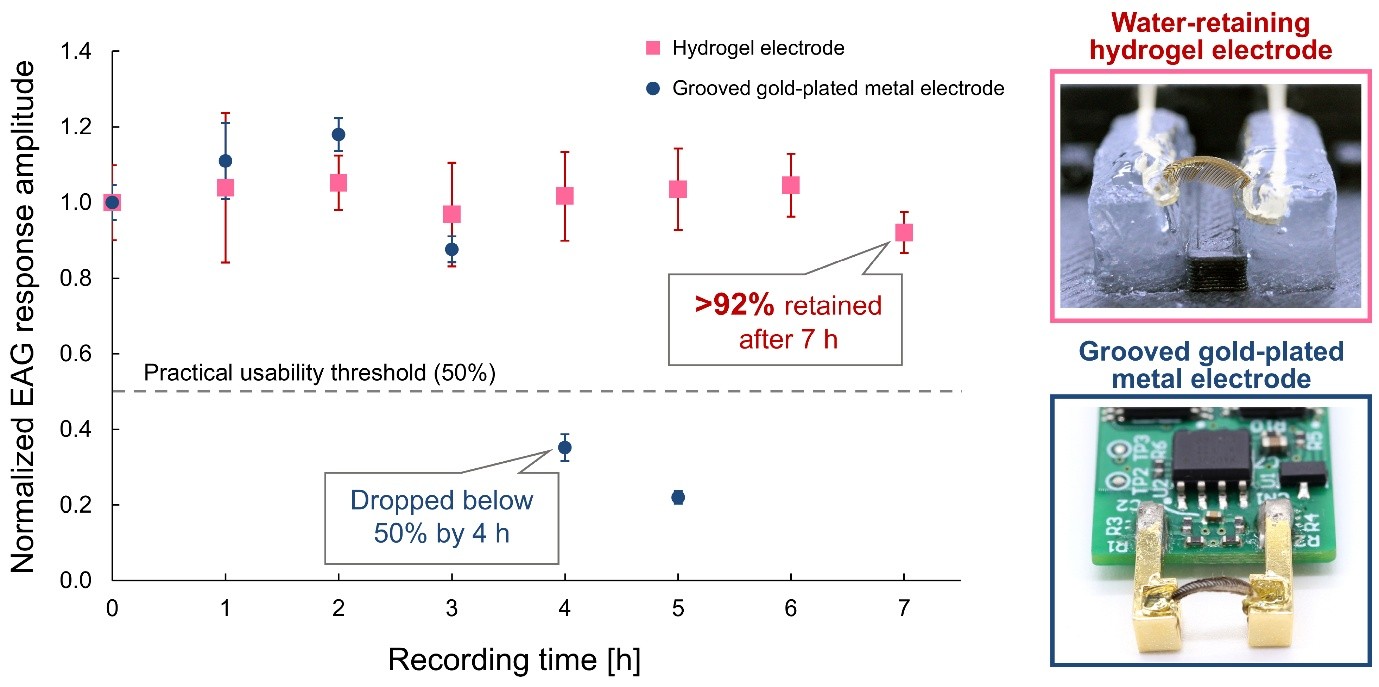
Image title: Seven-hour stability of insect-antenna EAG responses using a water-retaining hydrogel electrode
Image caption: Time-course comparison of EAG responses recorded using the hydrogel electrode and a conventional grooved gold-plated metal electrode. The hydrogel electrode retained more than 92% of the initial EAG response after 7 hours, whereas the grooved gold-plated metal electrode dropped below 50% by 4 hours under matched indoor test conditions.
Image credit: Dr. Daigo Terutsuki from Shinshu University, Japan
Reference
Title of original paper: Engineering electroantennogram interfaces through agar-based hydrogels for multi-hour recording and drone-mounted biohybrid odor sensing
Journal: Sensors and Actuators B: Chemical
Related SDGs