

From Flower Petals to Future Materials: The Hardy Ice Plant's Optical Innovation
- Share
- Tweet
- Send to email
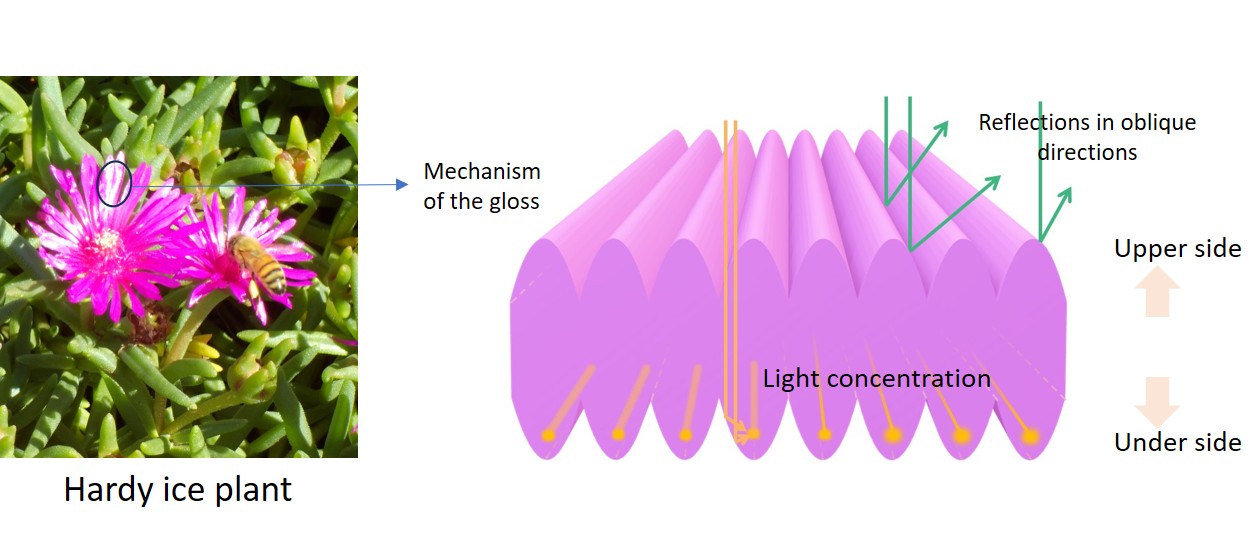
Image title: Petals that Reflect: Parabolic Surface Structures in the Hardy Ice Plant
Image caption: Microscopic parabolic ridges in the hardy ice plant’s petals create a natural glossy effect by controlling light reflection.
Image credit: Professor Hiroshi Moriwaki from Shinshu University, Japan
The secret behind this flower’s glossy appearance could inspire innovative optical materials of the future
What gives certain flowers their striking, glossy appearance? Researchers investigating the hardy ice plant uncovered a fascinating optical mystery hidden within the flower’s microscopic surface. By combining advanced imaging techniques with biomimetic material design, the study explores how nature manipulates light in unexpected ways. The findings not only deepen our understanding of plant optics but also open new possibilities for designing innovative reflective materials inspired by nature.
Nature is filled with remarkable visual phenomena created by microscopic surface structures that interact with light in fascinating ways. The iridescent wings of butterflies, the shimmering feathers of birds, and the glossy surfaces of flower petals are all examples of how living organisms control the reflection, absorption, and scattering of light. These optical effects are not only visually striking but also serve important biological functions, including attracting pollinators, communication, camouflage, and protection from environmental stress. Understanding these naturally occurring photonic structures has become an important area of research, as they provide inspiration for the development of advanced biomimetic materials and optical technologies.
One such example is the hardy ice plant, Delosperma cooperi, a perennial succulent native to South Africa and widely cultivated in Japan. The flower’s petals display a striking glossy appearance, prompting researchers to investigate the mechanism responsible for this effect. Researchers from Shinshu University, led by Professor Hiroshi Moriwaki, conducted this study to understand how the petals generate gloss and whether their surface structure could inspire the design of novel reflective materials. Mr. Kazuma Tanabe was also part of the research team. The findings were made available online in the journal Optical Materials on May 12, 2026, and will be published in Volume 177 of the journal on September 1, 2026.
To investigate this phenomenon, the researchers examined the petals using several advanced imaging and optical techniques, including scanning electron microscopy (SEM), confocal laser microscopy, optical digital microscopy, and angle-dependent reflectance measurements. They also evaluated whether pigments or surface waxes contributed to the glossy appearance. In addition, transparent resin replicas of the petal surface were fabricated using silicone molds and UV-curable resin to determine whether the optical effect could be artificially reproduced.
The study revealed that the glossiness of the hardy ice plant petals is not caused by pigments or waxes, as the glossy appearance remained visible even after the petals lost their reddish-purple pigmentation or after they were treated with chloroform. Microscopic observations instead showed that the optical effect originates from the unique surface architecture of the petals.
Prof. Moriwaki explains, “The surface of the petal consists of many micro-sized grooves with curves matching a parabola, and this structure reflects and concentrates light, producing a glossy effect. The front surface broadly reflects light, similar to a traffic mirror. On the back side, it concentrates light that has passed through the upper side.” He adds, “As a result, a distinctive gloss is created. It appears that the purpose of the gloss is to efficiently utilize sunlight reaching the petals and to attract insects that help transport pollen.”
Further analysis showed that these microscopic structures allow the petals to both scatter and directionally reflect light, creating gloss across a broad range of viewing angles. Unlike flowers that produce gloss through prism-like structures or thin-film interference, the hardy ice plant uses a distinctive parabolic surface architecture to manipulate light. The findings are significant for both biology and materials science. Biologically, the reflective petals may help attract pollinators such as bees or protect the flower from excessive sunlight exposure during long blooming periods. Technologically, the study demonstrates that nature-inspired microstructures can be used to create thin reflective materials without relying on conventional prisms or glass beads.
Inspired by this biological phenomenon, the researchers produced a resin molded from the petals of the hardy ice plant and demonstrated its potential as a reflective material. However, practical applications still face challenges related to production scale and manufacturing efficiency. “The ultimate goal is to devise a method for artificially producing a resin with a similar structure and to explore its application as a novel reflective material,” shares Prof. Moriwaki.
In conclusion, this study identified a previously unknown mechanism of biological gloss formation based on microscopic parabolic ridge structures in the petals of the hardy ice plant. By combining structural analysis with biomimetic material fabrication, the researchers demonstrated how natural surface geometries can efficiently manipulate light. These findings not only improve our understanding of plant optical properties but also provide valuable inspiration for the future design of innovative reflective materials and bio-inspired optical technologies.
Reference
Title of original paper: Parabolas in petal: Imitation of the glossy petals of hardy ice plant, Delosperma cooperi
Journal: Optical Materials
Related SDGs