

Unveiling Fungal Plant Infection Strategies to Reshape the Future of Crop Protection
- Share
- Tweet
- Send to email
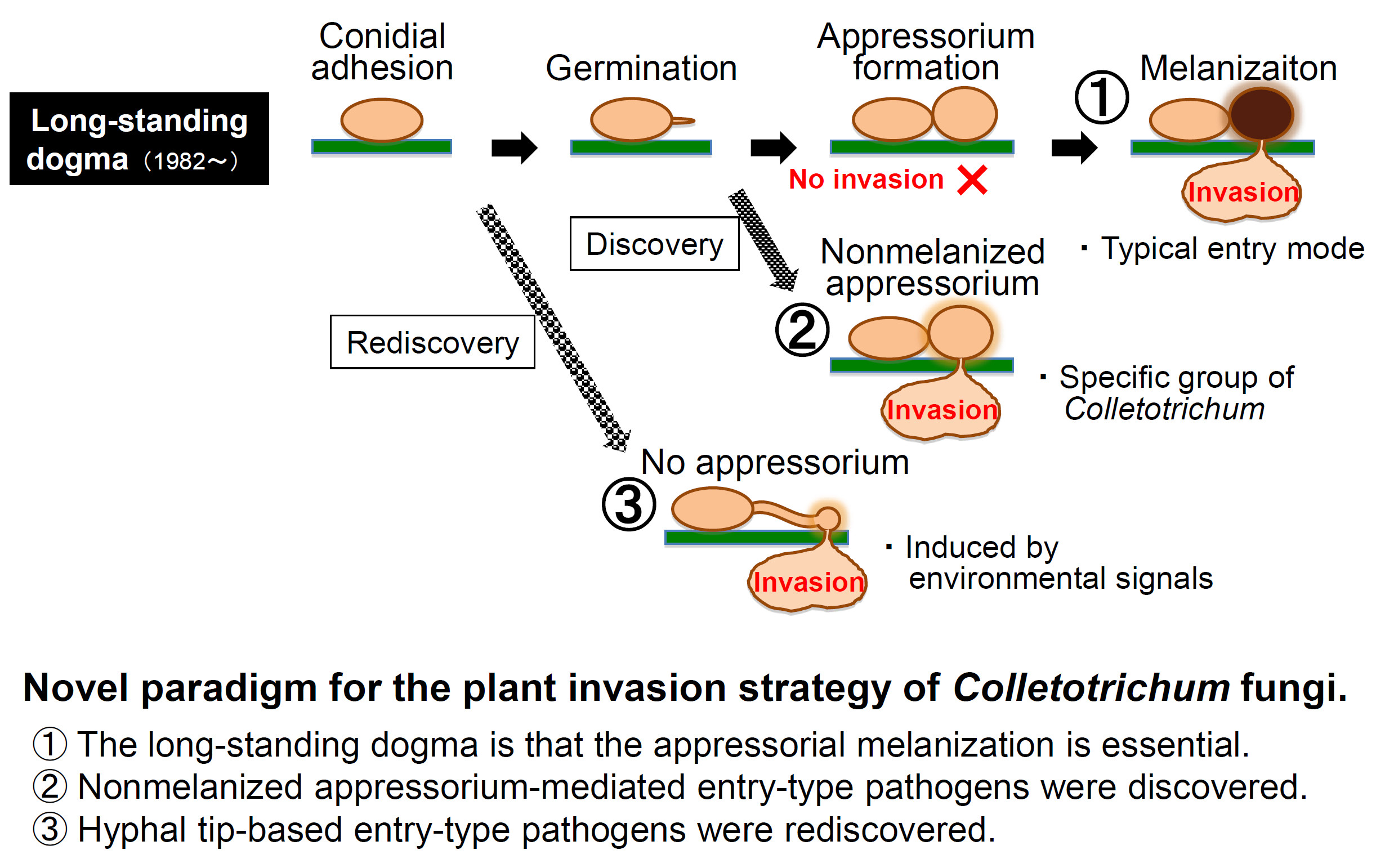
Image title: Breaking the long-standing dogma for plant invasion strategy of Colletotrichum fungi
Image caption: Researchers uncover alternative pathways used by Colletotrichum fungi to invade plants, shifting the long-standing dogma in plant pathology and demonstrating that appressorial melanisation is not universally required.
Image credit: Dr. Hiroki Irieda from Shinshu University, Japan
Researchers discover unexpected diversity in how destructive Colletotrichum pathogens invade plants, offering new insights for disease management
Plant-infecting fungi have evolved sophisticated strategies to overcome natural barriers and colonize their hosts. A new study investigates the biology of Colletotrichum fungi, among the world’s most destructive plant pathogens, to better understand the mechanisms that drive their success. By exploring how these pathogens interact with plant hosts, researchers uncover new insights into fungal adaptation and provide valuable knowledge that could help develop new strategies for protecting crops from devastating diseases.
Fungal diseases are one of the leading causes of crop destruction, threatening global food security and agricultural livelihoods. Among all the phytopathogenic fungi, the anthracnose fungi and the rice blast fungus are known to have a common infection strategy. They develop specialised melanised infection structures known as appressoria and exhibit melanised appressorium-mediated entry (MAE) into plant tissues. However, growing evidence suggested that some fungi may not follow this conventional model, raising the question of whether melanisation is truly indispensable for infection.
Now, a team of researchers led by Associate Professor Hiroki Irieda from Academic Assembly, Institute of Agriculture, Shinshu University, Japan, investigated whether all Colletotrichum species require melanised appressoria for plant invasion or whether alternative infection strategies exist. The study was published in Volume 17 of the journal Nature Communications on June 27, 2026.
“For human society, plant protection especially from fungal pathogens is a great concern. Hence, we investigated the molecular mechanisms underlying fungal infection strategy especially the invasion of pathogens into plants. Understanding this will help develop novel strategies for disease control and prevention,” says Dr. Irieda.
The researchers combined genetic, microscopic, physiological, and phylogenetic approaches to investigate infection strategies across multiple Colletotrichum species. They used melanin biosynthesis inhibitors and melanin-deficient mutants to prevent appressorial melanisation and examined fungal infection in host plants and immune-compromised Arabidopsis thaliana. High-resolution microscopy and functional analyses were used to evaluate appressorium development, penetration, and invasion, while phylogenetic analyses revealed the evolutionary relationships among fungi capable of melanisation-independent infection.
“Our study began with the discovery of an unusual Colletotrichum strain that remained unaffected by melanin biosynthesis inhibitors and could invade plants through nonmelanised appressoria. That unexpected observation prompted us to investigate whether melanisation is truly essential for plant invasion,” says Dr. Irieda.
The findings challenge a central assumption in fungal plant pathology, revealing melanised appressoria are not universally required for Colletotrichum infection. The researchers identified a novel infection strategy, termed nonmelanised appressorium-mediated entry (NMAE), in which fungi successfully invade plant tissues despite lacking melanin production. They found that the importance of melanisation differs among Colletotrichum species and that certain evolutionary lineages are enriched for NMAE-type fungi. Some strains were also capable of infecting plants naturally before their appressoria became melanised, demonstrating that melanisation may not always be the first or essential step in plant invasion.
In addition, they rediscovered a separate infection strategy, hyphal tip-based entry, revealing that Colletotrichum fungi can employ at least three distinct routes to invade plants. Together, these findings uncover unexpected flexibility in fungal infection mechanisms.
By revealing that some Colletotrichum fungi can infect plants without melanised appressoria, the study provides new insight into the diversity and evolution of fungal pathogenicity. The discovery highlights previously unrecognised infection mechanisms that could serve as future targets for disease management.
Notably, the study uncovers multiple pathways of plant invasion and demonstrates that melanisation is not a universal requirement, providing a foundation for developing next-generation crop protection strategies. As agricultural systems face increasing challenges from evolving fungal diseases, understanding these alternative infection routes could help develop more resilient approaches to safeguard global food production.
“Our study offers a new framework for the Colletotrichum fungi plant infection strategy, which requires a perspective shift from the conventional MAE-based single-entry mode to a diversified entry mode and may guide the development of more effective strategies for protecting crops against emerging fungal diseases,” concludes Dr. Irieda.
Reference
Title of original paper: Breaking dependence on melanisation imparts diversity to a dogmatic invasion strategy of phytopathogenic fungi
Journal: Nature Communications
Related SDGs