

Reinforced Enzyme Expression Drives High Production of Durable Lactate-Based Polyester
- Share
- Tweet
- Send to email
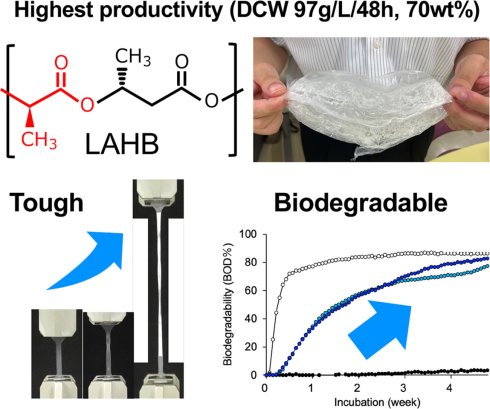
Image title: Lactate-enriched high-molecular-weight LAHB combines practical toughness with biodegradability
Image caption: Reinforced expression of the lactate-polymerizing enzyme gene in recombinant bacteria leads to enhanced production of poly[(D-lactate)-co-(R)-3-hydroxybutyrate] (LAHB) with improved toughness and biodegradability.
Image credit: Professor Seiichi Taguchi from Shinshu University, Japan
License type: CC BY 4.0
Usage restrictions: Credit must be given to the creator.
Researchers produce high-quality lactate (LA)-based polyester by reinforcing the gene expression of a LA-polymerizing enzyme in recombinant bacteria
Bio-based polyhydroxyalkanoates (PHAs) are considered one of the most promising sustainable alternatives to fossil-derived plastics. Poly[(D-lactate)-co-(R)-3-hydroxybutyrate] (LAHB) is an environmentally biodegradable microbial copolyester, and its lactate (LA) content significantly influences its properties. A new study shows how reinforcing the gene expression of the LA-polymerizing enzyme in a recombinant strain of Cupriavidus necator improves the LA fraction. The LA-enriched LAHB maintained a high molecular weight and displayed a balance of strength and elongation comparable to polyethylene.
Petroleum-based plastics are major contributors to environmental crises, threatening ecosystems, biodiversity, and human health. Biodegradable alternatives such as polyhydroxyalkanoates (PHAs), which are produced by microorganisms, can re-enter the natural carbon cycle and pose a viable alternative. Poly[(D-lactate)-co-(R)-3-hydroxybutyrate], or LAHB, a recently developed PHA, blends the qualities of poly(L-lactide) (PLLA), a bio-based plastic, renowned for its strength and transparency, and polyhydroxybutyrate, which biodegrades easily in natural settings. LAHB has proven to be biodegradable in soil, river water, coastal seawater, and even deep-sea environments.
One of the main factors regulating LAHB's material characteristics and its D-LA-L-LA-mediated interactions with PLLA is the lactate (LA) proportion. However, increasing the LA fraction to fine-tune performance while maintaining effective production of high-molecular-weight LAHB (hmw-LAHB) has proven to be a complex challenge that must be overcome to optimize LAHB for real-world applications.
To address this challenge, Professor Seiichi Taguchi from the Institute for Aqua Regeneration, Shinshu University, Japan, along with Dr. Sangho Koh from Shinshu University, Dr. Furutate Sho and Dr. Shunsuke Sato from the Green Planet Research Group, Agri-Bio & Supplement Research Laboratories, Kaneka Corporation, Japan, and Dr. Yusuke Imai from the Multi-Material Research Institute, National Institute of Advanced Industrial Science and Technology (AIST), Japan, attempted to reinforce the gene expression of the LA-polymerizing enzyme (LPE) in the recombinant strain of Cupriavidus necator. “This was one of the probable rate-limiting factors for LA-incorporation in LAHB. We wanted to see if this could result in increased productivity of LAHB with a good balance, satisfying both LA-fraction enrichment and high molecular-weight,” mentions Prof. Taguchi, while talking about the motivation behind the study. This study was made available online on December 31, 2025, and will be published in Volume 246 of the journal Polymer Degradation and Stability on April 1, 2026.
The primary objective of the study was to ensure an enhanced LA fraction while also achieving the highest titer of LAHB. To ensure LPE overexpression, an LPE-expressing plasmid vector,
pCUP-lacUV5-LPE, was introduced into the GS3 series of C. necator by electroporation. For fed-batch fermentation-based LAHB production, the GSXd147 strain was cultured with glucose used as the carbon source and ammonium hydroxide solution used for pH regulation. The initial glucose concentration was 20 g/L, and once the glucose was consumed to 10 g/L, the same concentration was maintained. The mechanical and thermal properties of the purified LAHB, along with LA fractions, were further assessed in the study.
Within 48 hours, the modified strain (GSXd147) reached 97 g/L dry cell weight (DCW) with 70 wt% of LAHB. This translates to the highest polymer titer for LAHB to date, at 68 g/L. “Compared to the previously utilized strain, GS3d147, for LAHB production, we observed more than a two-fold higher productivity along with improved LA incorporation,” mentions Prof. Taguchi. It also maintained a high molecular weight (Mw 30 × 104) along with a significantly high LA fraction of 15.4 mol%.
Mechanical tests revealed considerable differences between the new hmw-LAHB and its lower-molecular-weight counterparts. The majority of LAHB films clustered either at high elongation but significantly decreased strength or at high strength but were brittle. With its unique mix of ~20 MPa tensile strength and ~190% elongation at break, the hmw-LAHB was able to achieve mechanical properties that were comparable to those of traditional polymers like polyethylene.
The researchers observed that both high- and low-molecular-weight LAHB samples degraded effectively, achieving more than 75% biodegradation in 5 weeks, based on biochemical oxygen demand measurements in natural seawater. Degradation rates were similar despite a nearly eight-fold difference in molecular weight. This indicates that marine biodegradability is not hampered by molecular weight, which is essential for toughness, and establishes LAHB as a unique example that combines general environmental compatibility with improved mechanical performance.
The study demonstrates how bioengineering can directly translate into improved material performance at industrially relevant scales by solving a critical enzymatic bottleneck.
“High-quality biodegradable plastics are needed to address the environmental issue of microplastics. However, the intended plastics frequently lack the necessary physical properties. Our novel approach utilizes biotechnological methods to address these conflicting issues. This newly developed LAHB bio-based polymer with a high LA fraction will benefit the industry as a plastic polymer with outstanding marine biodegradability and useful material qualities,” concludes Prof. Taguchi.
|
Reference |
||
|
Title of original paper: |
Tough and biodegradable lactate (LA)-based polyester (LAHB) hyperproduced by reinforcing LA-polymerizing enzyme gene expression |
|
|
Journal: |
Polymer Degradation and Stability |
|
|
DOI: |
||
Related SDGs