

Shinshu University Finds No Price Drop in Fukushima Flounder After Treated-Water Discharge
- Share
- Tweet
- Send to email
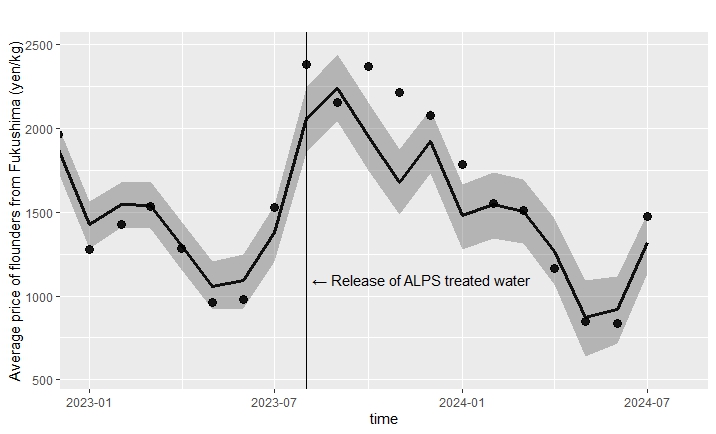
Image title: Predicted and actual price of flounder from Fukushima
Image caption: The filled points are the actual prices, the solid line is the predicted price, and the gray area is the 95% credible interval of Bayesian estimation.
Image credit: Associate Professor Keisuke Ishibashi from Shinshu University, Japan
License type: Original content
Usage restrictions: Cannot be reused without permission
An analysis by Shinshu University and the Distribution Economics Institute of Japan shows that wholesale prices for flounder—a key Fukushima catch—remained stable after the August 2023 ALPS-treated water discharge. Using a predictive market model based on pre-discharge data, the study found no significant price decline, providing reassurance for fisheries stakeholders and informing future policy debates on nuclear-water disposal.
Fukushima’s fisheries have faced years of economic and emotional uncertainty ever since the 2011 nuclear accident disrupted marine ecosystems, damaged consumer trust, and placed a heavy burden on local livelihoods. When the Japanese government began releasing the Advanced Liquid Processing System (ALPS)-treated water from the Fukushima Daiichi Nuclear Power Plant into the ocean in August 2023 as part of its long-term decommissioning strategy, a new surge of public concern emerged. Although the water underwent multi-stage processing to remove radioactive contaminants and met the international safety standards, many feared that seafood originating from nearby waters would be rejected, triggering a steep price decline, especially for flounder, one of Fukushima’s most commercially important fish.
To provide a clear, scientific assessment of the economic impact, researchers led by Associate Professor Keisuke Ishibashi of Shinshu University, Japan, in collaboration with Dr. Maika Sasaki from the Distribution Economics Institute of Japan, turned to quantitative analysis. They focused not on speculation but on market behavior, tracking how wholesale prices actually changed after the treated-water discharge began. Using government transaction statistics from the Tokyo Central Wholesale Market, the team developed an econometric model capable of predicting what flounder prices should have been under normal conditions. They then compared this baseline to real-world price movements after the discharge.
This paper was made available online in the journal Fisheries Science on November 11, 2025, providing the first rigorous evaluation of seafood market responses to treated-water discharge. The analysis incorporated seasonal supply patterns, variations in landed volume, and broader market influences to isolate any specific economic impacts attributable to the discharge event.
Contrary to widespread fears, the results revealed no signs of a market downturn. Wholesale prices of flounder sourced from Fukushima remained stable and performed consistently with —and at times above—model projections. “Our study shows that there is no statistical evidence linking the treated-water discharge to a price in flounder—a hopeful sign for fisheries,” said Dr. Ishibashi.
The implications are significant: despite strong public emotions surrounding nuclear safety, consumers did not appear to withdraw their support for Fukushima flounder in the marketplace. Dr. Ishibashi emphasized the importance of evidence-based assessment, stating, “Using reliable government data and robust statistical modeling, we aimed to cut through speculation to show what actually happened.”
However, the researchers remain cautious about generalizing too broadly. The team recommends expanding similar analyses to other fish and shellfish caught in Fukushima waters to better understand consumer attitudes across the seafood supply chain.
Still, the findings deliver timely reassurance for an industry operating under intense scrutiny. Fishermen have repeatedly expressed fear that their livelihoods could be jeopardized by consumer distrust. This study provides a counterweight to those anxieties, demonstrating that market reactions may be more resilient than expected when scientific monitoring confirms safety.
Globally, the work offers a model for how governments and industries can evaluate the socio-economic impacts of environmental risk-management policies. As many nations face decisions about wastewater treatment from nuclear facilities or other sensitive industrial sources, data-driven analysis like this can help guide communication strategies, strengthen public trust, and safeguard local economies.
For Fukushima’s fishing communities, still working to restore pride and prosperity nearly 15 years after the disaster, the stability of flounder prices is more than an economic metric. It is a sign of gradual recovery and renewed confidence, suggesting that careful monitoring, transparent policy, and scientific evidence can help navigate even the most controversial environmental challenges.
|
Reference |
||
|
Title of original paper: |
Impact of ALPS‑treated water discharge from the Fukushima Daiichi nuclear power plant on flounder price |
|
|
Journal: |
Fisheries Science |
|
|
DOI: |
||
Related SDGs