

Can Certain Bacteria Regulate Aging of the Immune System and Its Related Alterations?
- Share
- Tweet
- Send to email
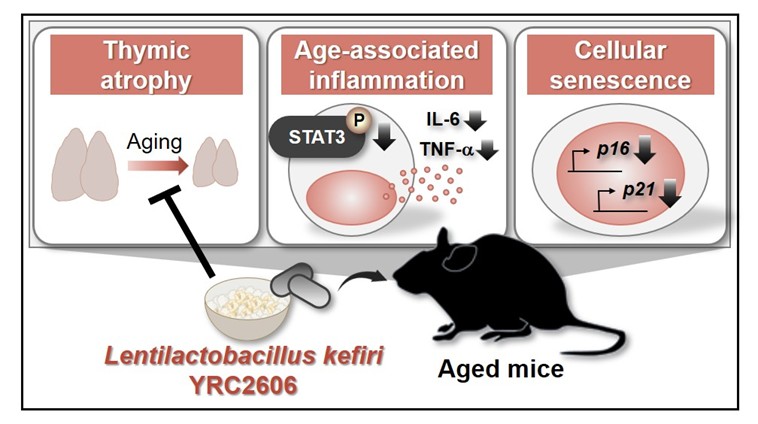
Image Title: Impact of heat-killed Lentilactobacillus kefiri YRC2606 on aging-related immunosenescence
Image Caption: Heat-killed L. kefiri YRC2606 attenuates immunosenescence by suppressing IL-6/STAT3 signaling and alleviating thymic atrophy, thereby reducing inflammatory cytokine production and senescence marker expression in aged mice.
Image Credit: Ms. Hiroka Sasahara from Shinshu University, Japan
License type: Original content
Usage restrictions: Cannot be used without permission. Credit must be given to the creator.
Researchers from Japan evaluated the impact of heat-inactivated Lentilactobacillus kefiri YRC2606, isolated from kefir, on age-related inflammation
The process of aging is associated with a decline in immune functions and persistent low-level inflammation. Now, researchers from Japan have discovered a strain of Lentilactobacillus capable of preventing and even reversing aging-related immune alterations. Feeding aged mice with heat-inactivated YRC2606 resulted in lowered levels of inflammatory cytokines and signaling proteins. These findings point to the possibility of a functional food intervention that has the potential to benefit an increasingly aging population.
The health benefits of consuming fermented milk products have been passed down through generations, without clearly understanding their full impact on human health. Fermented milk products like kefir have lactic acid bacteria, or LABs, which are reported to exhibit anti-microbial, anti-inflammatory, and anti-cancer effects. However, the actual mechanisms behind these effects are not clearly understood.
To address this gap, Ms. Hiroka Sasahara, a doctoral student at the Division of Biological and Agricultural Sciences, Shinshu University, Japan, together with Professor Sachi Tanaka at Shinshu University, teamed up with Dr. Kenji Uchida and Ms. Ikumi Fujioka from the R&D Centre of Yotsuba Milk Products Co., Ltd., to investigate the potential of a new functional food capable of preventing age-related inflammation processes.
In their recent study, made available online on October 10, 2025, and published in Volume 134 of the Journal of Functional Foods on November 1, 2025, the researchers investigated the impact of Lentilactobacillus kefiri YRC2606, a bacterial strain isolated from kefir, on immune function during aging. Explaining her motivation for this study Ms. Sasahara said, “My interest in studying immunosenescence is driven by a deep curiosity about aging, a universal biological process that everyone experiences. My objective is to explore functional interventions derived from everyday foods and their potential to become evidence-based strategies against aging.”
Aging is accompanied by a decline in protective immune function and a biological slowing of immune cells, also referred to as senescence. Senescence halts cell division and triggers persistent low-grade inflammation, the root cause of age-related diseases. Slow wasting or atrophy of organs like the thymus and liver is also observed with aging. In this study, the authors administered heat-inactivated L. kefiri YRC2606 to aged mice for 8 weeks and investigated its impact on their immune functions.
The researchers observed that YRC2606 feeding reduced age-related alterations of vital organs such as the thymus and liver. Animals fed with the YRC2606 strain were to exhibit a reduced expression of key proteins p16 and p21 that block cells from dividing. Further evidence for anti-inflammatory activity was collected from the study of the bacterial lipopolysaccharide-mediated inflammation process. Cells from YRC2606-fed animals secreted considerably reduced levels of the inflammatory cytokines, interleukin (IL)-6 and TNF-α. Notably, the levels of signaling protein phosphorylation of signal transducers and activators of transcription (STAT) 3, which is an important component of inflammation, was also reduced.
Given the increasingly aging population in Japan, the relevance of the study findings are evident. “To our knowledge, this is the first report demonstrating that inactivated L. kefiri attenuates immunosenescence by regulating the IL-6/STAT3 pathway and alleviating thymic atrophy, highlighting its unique potential as a probiotic for age-related immune decline,” Ms. Sasahara explains. She further adds, “YRC2606 will be useful for the treatment of age-associated diseases, for example, as an ingredient in functional foods or dietary supplements designed to maintain immune function in older adults.”
The development of functional foods like YRC2606 is also theorized to boost the economic returns of the Japanese food industry. Most importantly, its potential to mitigate age-related immune deterioration may help in the maintenance of physiological function in older adults, thereby reducing future healthcare expenditure.
|
Reference |
||
|
Title of original paper: |
Orally administered heat-killed Lentilactobacillus kefiri YRC2606 regulates immunosenescence in aged mice |
|
|
Journal: |
Journal of Functional Foods |
|
|
DOI: |
10.1016/j.jff.2025.107053 |
|
Related SDGs