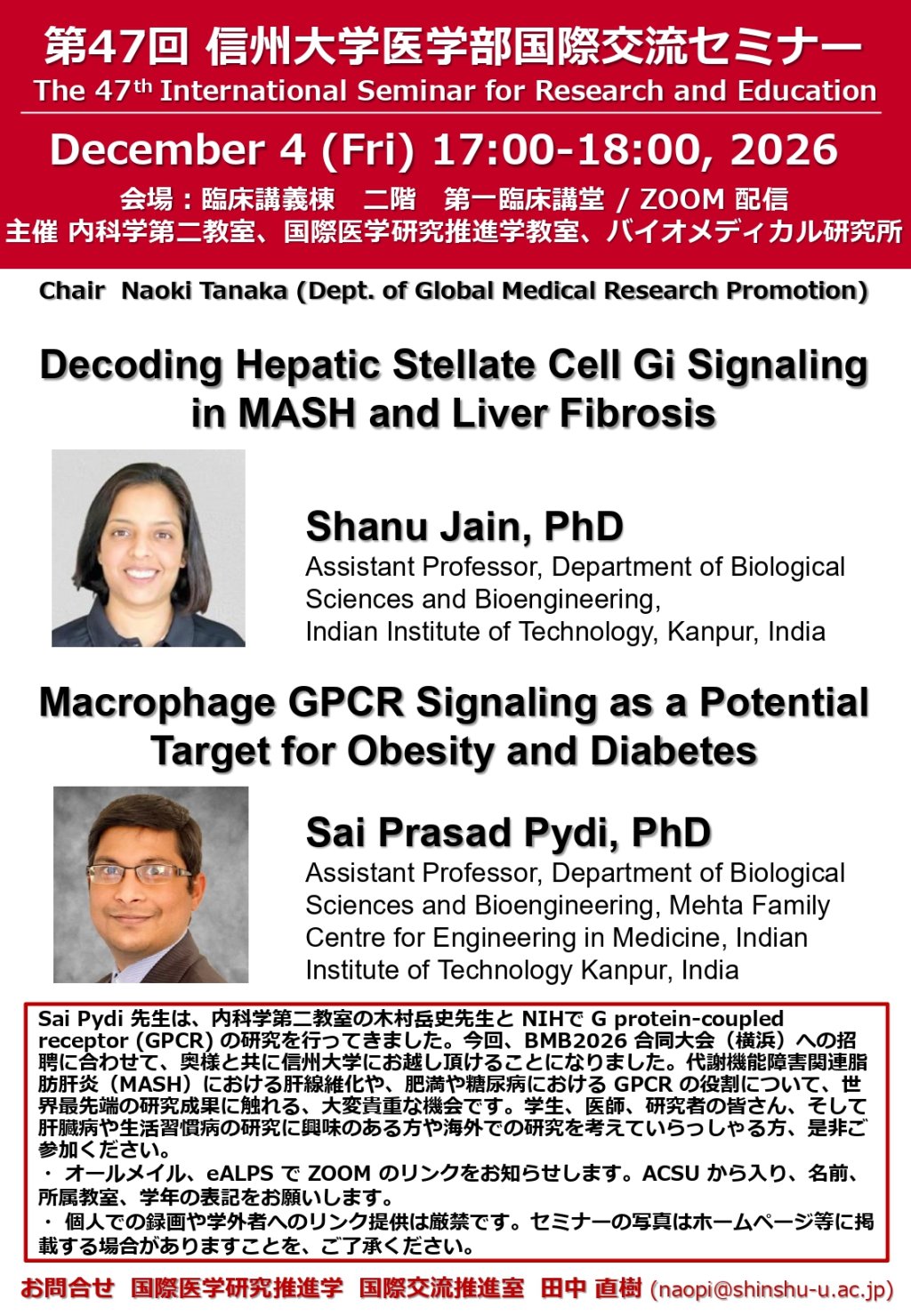
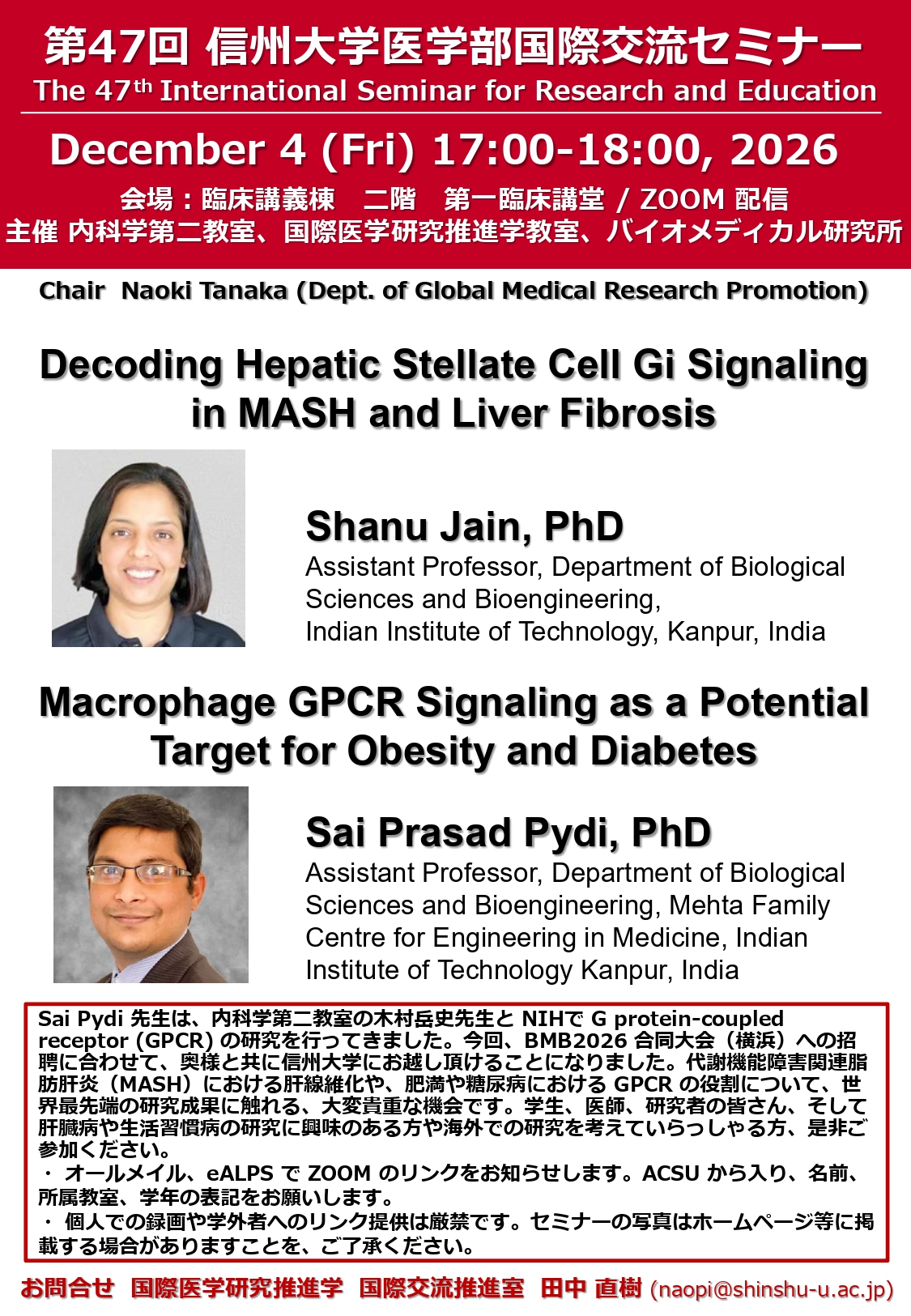
[内科学第二教室、国際医学研究推進学教室、バイオメディカル研究所 主催] 第47回 医学部国際交流セミナーのお知らせ
教員・研究者・大学院生・医学部生 各位
Sai Pydi 先生は、内科学第二教室の木村岳史先生と NIHで G protein-coupled receptor (GPCR) の研究を行ってきました。今回、BMB2026 合同大会(横浜)への招聘に合わせて、奥様と共に信州大学にお越し頂けることになりました。代謝機能障害関連脂肪肝炎(MASH)における肝線維化や、肥満や糖尿病における GPCR の役割について、世界最先端の研究成果に触れる、大変貴重な機会です。学生、医師、研究者の皆さん、そして肝臓病や生活習慣病の研究に興味のある方や海外での研究を考えていらっしゃる方、是非ご参加ください。ZOOMでの配信もありますので、気軽にご参加ください(登録不要)。
記
【日時】 令和8年12月4日(金)17:00~18:00
【会場】 臨床講義棟 二階 第一臨床講堂
【講演】
1. Decoding Hepatic Stellate Cell Gi Signaling in MASH and Liver Fibrosis
Shanu Jain
Assistant Professor, Department of Biological Sciences and Bioengineering,
Indian Institute of Technology, Kanpur, India
Hepatic stellate cells (HSCs) are the major drivers of liver fibrosis, yet therapies specifically targeting HSCs remain lacking. G protein-coupled receptors (GPCRs), a large family of membrane proteins, are abundantly expressed in HSCs and represent promising therapeutic targets. In this study, we investigated HSC Gi signaling in MASH and liver fibrosis using in vivo MASLD mouse models. Our findings demonstrate that inhibiting HSC Gi signaling reduced HSC activation and hepatic steatosis while improving hepatocyte function and metabolism. These findings identify HSC Gi signaling as a promising therapeutic target for developing innovative treatments for MASH and liver fibrosis.
2. Macrophage GPCR Signaling as a Potential Target for Obesity and Diabetes
Sai Prasad Pydi
Biological Sciences and Bioengineering, Mehta Family Centre for Engineering in Medicine, Indian Institute of Technology Kanpur, India
Obesity promotes insulin resistance through chronic low-grade inflammation, with macrophages playing a central role. However, how macrophages regulate glucose metabolism and whole-body energy homeostasis remains poorly understood. Macrophages express numerous G protein-coupled receptors (GPCRs) that signal through four major G protein families: Gs, Gi, Gq, and G12/13. Using DREADDs, we selectively manipulate individual G protein pathways in myeloid cells in vivo. Our findings reveal that macrophages are not uniformly pro- or anti-inflammatory; instead, distinct GPCR pathways engage specific tissues through distinct mediators. We recently showed that macrophage Gq signaling releases sphingolipids that suppress glucose-stimulated insulin secretion from pancreatic β-cells and identified GPR18, activated by N-arachidonoyl glycine, as the endogenous receptor mediating this axis (Singh & Kumar et al., JCI, 2026). Current studies show that Gs activation increases energy expenditure through adipose tissue, whereas Gi activation promotes IL-1β-dependent insulin resistance in muscle and fat. These findings reveal pathway- and tissue-specific mechanisms for GPCR-directed therapeutic strategies in obesity and type 2 diabetes.
Flyerはこちらから
【ZOOM リンク】
医学部オールメール(11月25日および12月3日 配信予定)にてご確認ください。
【注意事項】
・ ZOOM のリンクへACSU から入り、名前、所属教室、学年の表記をお願いします。
・ 個人での録画や学外者へのリンク提供は厳禁です。セミナーの写真はホームページ等に掲載する場合がありますことを、ご了承ください。
【お問い合わせ】
医学部 国際医学研究推進学 国際交流推進室 教授 田中 直樹
naopi@shinshu-u.ac.jp