

For approximately two weeks, from Tuesday, May 26 to Saturday, June 6, 2026, Shinshu University conducted a short-term study program "Green Shinshu" and hosted students from its partner universities in the United States as part of the Program of the Inter-University Exchange Project. (For more details about the program overview, please see the article here.)
Throughout the program, Shinshu University student supporters played an active role in assisting with its organization and activities. We are pleased to share their reports, which provide an overview of each day's activities, highlights from the program, and personal reflections from the students' perspectives. (For Week 1, please see the article here.)

【Day7】Agriculture and Washoku Experience: Visit wasabi fields and soba-making workshop
It was a beautiful, hot day. Upon arriving at the Kuroiwa Wasabi Farm, we changed into rubber boots to enter the wasabi fields. Since the fields are fed by snowmelt from the Alps, the water felt incredibly cold--so much so that we completely forgot about the heat. During our first-ever wasabi harvesting experience, we discovered that the plants were rooted much more firmly than they looked. Following the farmer's advice, we loosened the surrounding gravel bit by bit, then gave a spirited, decisive tug; the large plant came free with a satisfying *zaza* sound.
After visiting the Kuroiwa Wasabi Farm, we tried our hand at making soba noodles at "Kone-kone House." Guided by the explanations and demonstrations of the facility staff, the students enjoyed every step of the process--from mixing the buckwheat flour to rolling out and cutting the dough.


We ate the finished soba as *zaru soba* (chilled noodles) accompanied by tempura. We also grated the fresh wasabi we had harvested earlier right there on the spot to enjoy with the noodles. Many students seemed to be thoroughly enjoying this unique aspect of Japanese food culture.
Afterward, we visited the "Daio Wasabi Farm," where we strolled freely around the grounds and bought souvenirs. Many students also tried the farm's famous wasabi soft-serve ice cream; they were surprised by its unique flavor but clearly enjoyed the experience.
【Day8】Rice Planting in Azumino
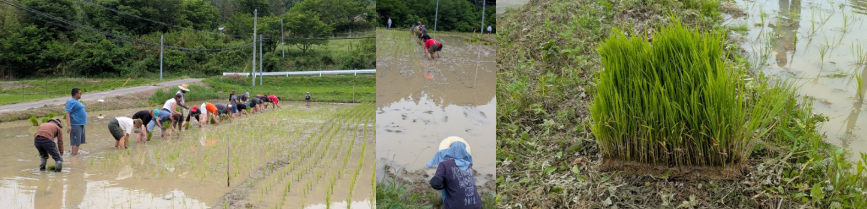
Today in Azumino, we took part in the agricultural experience we had been looking forward to most: working in the rice paddies. In the morning, we visited the paddy of a farmer who holds a Guinness World Record for *kendama* (a traditional Japanese skill toy). We started with a game to find "two *kendama*" hidden in the mud. It was a time filled with smiles as we enjoyed the cool sensation of the mud and encountered various creatures living in the paddy.
Afterward, we tried our hand at planting rice by hand. We planted seedlings in groups of three to seven along the guide ropes; even with a large group, the process took a long time, and we realized just how difficult it is to create neat, straight rows. Getting covered in mud gave us firsthand insight into the challenges of growing crops, making it a valuable day that deepened our appreciation for the daily work of rice farming and the farmers themselves.
For lunch, we used rice from a farmer who had won the top award in Japan, cooking it authentically in a *nukakudo* (a traditional stove fueled by rice husks). Unlike standard *kamado* stoves, the *nukakudo* uses rice husks as fuel. By utilizing not only the harvested rice but also the husks--a byproduct--we contribute to waste reduction and lower fossil fuel consumption; we learned that the *nukakudo* is a sustainable method that supports a circular society.
While waiting for the rice to cook, we attended a lecture on the paddy field ecosystem and performed a *kamishibai* (traditional Japanese paper-theater storytelling) presentation for the American students. We translated our original script into English as much as possible and enlisted other support members to play the various characters in the story. Afterward, we shaped the freshly cooked rice into *onigiri* (rice balls) and enjoyed them with pickles and miso soup; the taste was exceptional--so delicious that everyone was moved, calling it the best rice they had ever eaten.
After lunch, the farm owner demonstrated *kendama* (a traditional Japanese skill toy), and we all tried our hand at the tricks before heading back. Students who successfully performed a trick were even gifted a *kendama*, making for a heartwarming time filled with smiles right up to the very end.
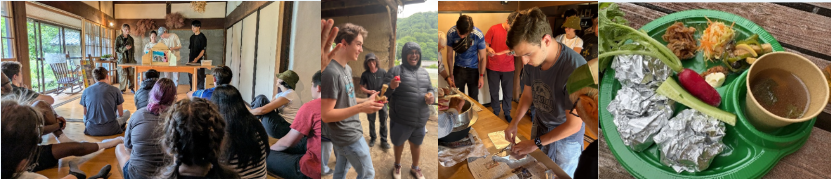
In the afternoon, we visited a historic building in Azumino City that had served as a rest stop for *sankin-kotai* (the feudal lords' mandatory travel to the capital) during the Edo period. Although it currently operates as a hotel, the atmosphere of the past remains intact. The unique architectural layout--featuring waiting rooms for retainers and private chambers for the feudal lord--differs greatly from modern structures, offering us a glimpse into the lifestyle of that era.

【Day9】Onion dishes, Azumino
On the ninth day, after touring a miso brewery, we were originally scheduled to harvest onions; however, due to bad weather, the activity was changed to an indoor lecture. Instead, we enjoyed a lunch featuring plenty of onions. Afterward, at "Village Azumino," staff members taught us about agriculture and water usage in the area. We participated in a water-tasting activity comparing three different types of water and walked around the Village Azumino grounds to see what we had learned firsthand. We received clear explanations about the flow of water in Azumino and the local faith in Dosojin (roadside guardian deities), allowing us to learn a great deal about things we hadn't known before. It was fascinating to hear how farmers in the past would pray to the gods for the prosperity of their descendants and bountiful harvests; they conveyed these wishes by placing *Jizo* statues everywhere and holding festivals.

【Day10】Oyaki Making and Visiting a Sake Brewery
This was the final activity of the program, and we started the morning by making *oyaki* (Japanese dumplings). We made two varieties: eggplant with miso, and bamboo shoot. The women who taught us were very kind; when several students--myself included--struggled to shape them correctly, they patiently explained the steps to us over and over again. While waiting for the *oyaki* to finish baking, we enjoyed chatting over tea.

After making the *oyaki*, we visited the "Daisekkei Sake Brewery." There, we learned about the sake production process and the optimal brewing seasons regarding flavor and preservation. At the end of the explanation, we toured the factory and saw how sake is stored, as well as the machinery used for winter brewing. To wrap up the tour, we enjoyed tasting the sake they had prepared for us. Personally, the *Junmai Ginjo* was my favorite.
【Day12】Final Presentation
On the final day of the program, Japanese and American students formed mixed groups to deliver final presentations based on the experiences and field trips they had undertaken during the program.
For the assignment, each group selected one of five UN Sustainable Development Goals (SDGs): Goal 2 (Zero Hunger), Goal 11 (Sustainable Cities and Communities), Goal 12 (Responsible Consumption and Production), Goal 13 (Climate Action), or Goal 15 (Life on Land). Members from Japan and the U.S.--bringing diverse cultural backgrounds--engaged in enthusiastic discussions to analyze current issues and devise solutions.They collaborated to create their presentation materials and then delivered 20-minute presentations.


Our group chose Goal 11, "Sustainable Cities and Communities." We selected this goal because everything we had visited and experienced was linked to concepts like "sustainability" and "proactive initiatives," making it the easiest theme around which to structure our presentation. We highlighted our day trip to Nagawa as a prime example of self-reliant sustainability. We also explained how that trip helped us realize that virtually every aspect of the Matsumoto region is connected to sustainability processes, making it easier for us to identify the region's sustainable qualities. Other groups also delivered excellent presentations, addressing issues that hadn't occurred to us; this broadened our perspectives and prompted us to reflect on topics we hadn't deeply considered before.
Following the presentations, a completion ceremony was held, and each student was awarded a certificate. At the final dinner, we exchanged contact information; it was a heartwarming occasion filled with the bittersweet feeling of parting ways and promises to meet again. This experience, which allowed us to deepen our understanding of each other's values, became a lifelong treasure for everyone involved.

Written by 4 Student Supporters of the Inter-University Exchange Project : AN, M, B and N