Profile of Divisions

- Division of International Collaborative Research
- Division of Mountain Ecosystem Science
- Division of Geomorphology, Geology and Disaster Prevention
- Division of Forest Resources Research
- Division of Atmospheric, Water, and Soil Environmental Science
- Division of Graduate Education and Research Collaboration
Division of International Collaborative Research
We will promote collaboration with research institutions and individual researchers, both domestic and international. We will conduct comparative studies on the impacts of global warming on mountain regions, topography, biological evolution and mountain cultures. To this end, we will oversee joint research projects and invite researchers.
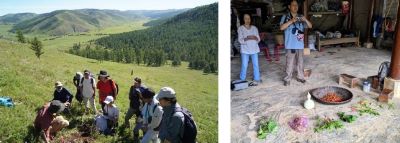
- Forest ecosystem survey in Mongolia
- Collection of plant genetic resources
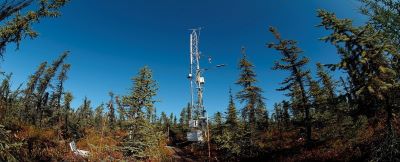
- Meteorological observation tower installed in a black spruce forest on permafrost in Fairbanks, Alaska, USA, to evaluate forest CO2 absorption
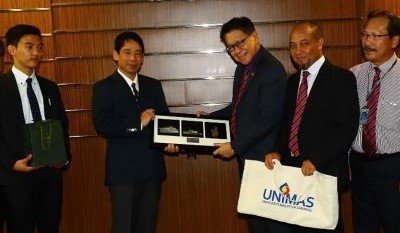
- Signed an MOU with Institute of Borneo Studies, Universiti Malaysia Sarawak
Division of Mountain Ecosystem Science
The Department of Mountain Ecosystem studies in the adaptation of wildlife to severe habitats and cold climates including alpine regions, monitors biomes on the mountainous regions in response to the global warming, and surveys responses of aquatic ecosystem against environmental fluctuations including global climate change. Based on these studies, we estimate future images of ecosystems in mountain regions and related river basins, and release research finding for both academic areas and citizens.
- Group of Argali in Kyrgyzstan.
- A typical alpine legume in Japan, Oxytropis japonica.
- Observation of water quality at Lake Suwa.
- Basidiomata of Tricholoma matsutake occurred in a subalpine Abies veitchii forest on Mt. Norikura-dake.

Division of Geomorphology, Geology and Disaster Prevention
The Department of Geomorphology, Geology and Disaster Prevention focuses on the process of formation-variation-disappearance in mountain and alpine environments in the Japanese Alps and Himalayans. The department proposes science-based schemes to conserve alpine environments and reduce natural disasters.
- Mount Nilgiri.
- Yari-Hotaka Mountain Range.

Division of Forest Resources Research
The Department of Forest Resource aims to contribute to manage and utilize forest resources that are necessary for sustainable development of the mountainous community. We focus on assessment of effects of climate on forest and its ecology, understanding and prediction of forest resources including food and development on sustainable utilization technologies.
- Tree-ring cores sampling for analysis on climate responses of tree growth.
- High-precision individual tree detection in Shinshu University Campus forest with airborne LiDAR date.
- Exploration of plant genetic resources in Western Nepal.
- History of Architecture in the Mountains(Mountain Huts in the Japanese Alps Region).

Division of Atmospheric, Water, and Soil Environmental Science
This division conducts research on both the physical aspects, such as meteorology and hydrology,and the ecological aspects, including the role of organisms in the carbon and water cycles, of the mountain environment. By integrating these studies, we aim to elucidate the interactions between the atmosphere, hydrosphere, and biosphere.
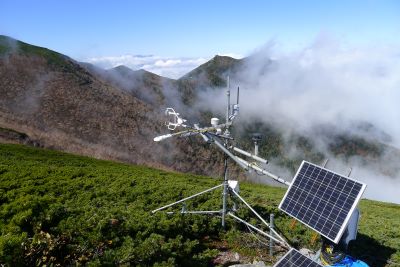
Research keywords: Greenhouse gas exchange, Groundwater flow, Snow and ice, Root system,Phytoplankton, Soil microorganisms, Methane production- Monitoring Greenhouse Gas Exchange in the Aromatic Pine Ecosystem
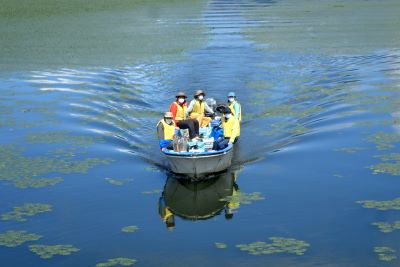
- Observations in Lake Suwa
Division of Graduate Education and Research Collaboration
We bring up the specialist who can contribute to education of environmental change, prevent a disaster and reduce it, biological diversity through " Mountains Science program".
- Mt. Gakidake(2647m), Northern Japan Alps.
- Seminar in mountain field.
