Seven Years of Water and CO₂ Exchange Between Dwarf Pine Vegetation and the Atmosphere in the Japanese Alps
2026/10/16
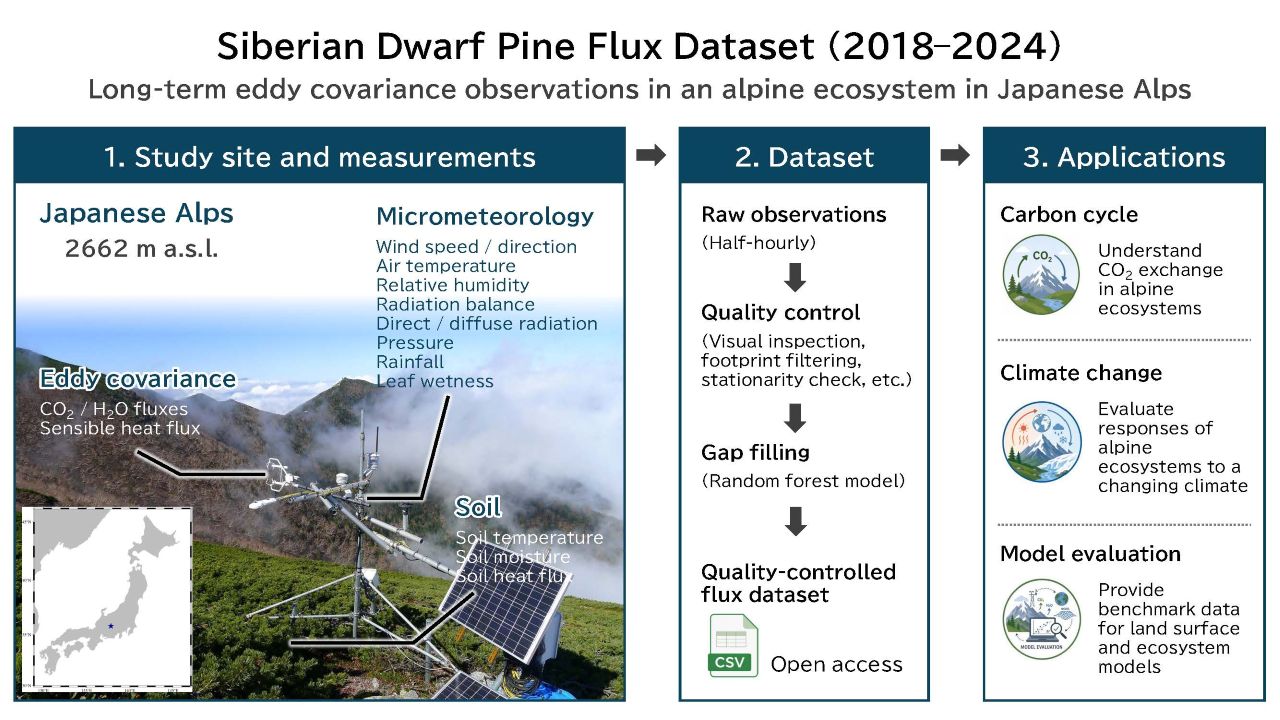
A research team led by Hiroki Iwata at Shinshu University has compiled and released seven years of observations, from 2018 to 2024, from a dwarf pine ecosystem at an elevation of 2,662 metres in the Central Japanese Alps. The records show how exchanges of water and CO₂ change with the seasons, from snowmelt through to winter. They provide a foundation for understanding alpine environments, where observations remain scarce, and for investigating the impacts of climate change.
How alpine plants interact with the atmosphere
In the Japanese Alps, dwarf pine, a low-growing conifer, covers areas above the elevation where tall trees can grow. Plants take up CO₂ through photosynthesis, while respiration by plants and soil organisms releases CO₂. Water evaporating from the ground and plants also carries heat into the atmosphere. Measuring these exchanges is essential to understanding the role of alpine ecosystems in the water and carbon cycles. However, snow, harsh weather and the difficulty of transporting equipment have limited long-term observations.
Measuring water and CO₂ exchange through air movement
The observation site is on a slope near Shogino-Kashira in the Central Japanese Alps. The researchers measured vertical air movement and the concentrations of water vapour and CO₂ ten times per second. By analysing how these measurements varied together, they calculated the amounts exchanged between the ecosystem and the atmosphere. This technique is called eddy covariance. They also recorded solar radiation, air temperature, soil moisture and other environmental conditions. Gaps in the observations were filled using machine learning, which learns relationships within the available data. The published dataset clearly distinguishes measured values from estimates.
How CO₂ and water exchange change after snowmelt
CO₂ uptake began after snowmelt. On average, net daily uptake—the amount absorbed during the day minus the amount released at night and at other times—was greatest in June. Daytime uptake, however, was strongest in August. Because respiration also releases more CO₂ in summer, the period with the strongest daytime uptake differed from the period with the greatest net uptake over a full day.
The heat carried into the atmosphere by evaporating water increased after snowmelt, with the largest daytime peak in August. In spring, heat transfer that directly warmed the air was dominant. By midsummer, heat transfer associated with evaporation had become comparable in magnitude. The researchers also checked the quality of the measurements on the slope by examining atmospheric turbulence and the balance between incoming and outgoing energy.
Open data for studying the impacts of climate change
The publicly available dataset includes records at 30-minute and daily intervals, together with information on data quality and uncertainty in the estimates. It is expected to help researchers investigate how differences in snowmelt timing and temperature affect alpine water and carbon cycles, and to test ecosystem models and estimates derived from satellite observations. Long gaps in the winter and spring records, together with possible instrument effects on winter CO₂ measurements, mean that annual balances and differences between years need to be assessed carefully.
Publication details
Authors: Hiroki Iwata, Ryo Sato, Naoki Makita, Hajime Kobayashi, Hiroyuki Oguma
Title: A 7-Year Eddy Covariance Dataset of the Energy, Water Vapour and Carbon Dioxide Fluxes Observed in a Siberian Dwarf Pine Ecosystem
Journal: Geoscience Data Journal, 13, e70101 (2026)
Article: https://doi.org/10.1002/gdj3.70101
Dataset: https://doi.org/10.5281/zenodo.21995728